There is a new hope today for those people suffering from liver diseases. Also a good food supplement to protect our liver and keep it healthy for any type of liver infections that may enter into our body. This is the Silymarin. Let me explain what Silymarin is.
Silymarin refers to the extract from the seeds of the plant Silybum marianum, also called "milk thistle". It has been used for over 2,000 years. During the Middle Ages the seed of the milk thistle was commonly used to treat liver diseases. It has also been extensively researched in Europe for over 30 years. Studies abroad and in the United States have suggested that Silymarin nutritionally supports healthy liver function. There have been over 300 scientific studies of silymarin that documents:
•Treatment of cirrhosis of the liver caused by alcoholism
•Treatment of chronic hepatitis
•Treatment of poisoning due to eating wild mushrooms
•Helping the liver repair itself
Most of the scientific studies of silymarin were published in Europe.
The active ingredients of milk thistle are chemicals called flavonoids. The flavonoids in milk thistle are silybin, silydianin, and silychristin. Together, they are called silymarin.
Antioxidant effects
Milk thistle prevents toxins from entering the liver by guarding the organ's numerous doorways-the membranes of liver cells. By slowing the rate at which the liver absorbs harmful substances, the toxins are excreted through the kidneys before they can cause liver damage. Much of Milk Thistle's protective effect is due to the flavonoid complex silymarin, which acts as a powerful antioxidant, combining with and thus neutralizing harmful free radicals that result from normal metabolic processes and from the breakdown of toxic substances. At least 10 times as potent as vitamin E, silymarin also helps increase levels of two additional antioxidants, glutathione and superoxide dismutase (SOD). Silymarin may increase glutathione content in the liver and intestines by up to 50 percent. Silymarin also increases the activity of SOD in erythrocytes (red blood cells) and lymphocytes (white blood cells) formed in the lymphatic tissue in patients with liver disease. Because silymarin is a potent antioxidant in the stomach and intestines, it may also have a role to play in treating inflammatory conditions such as colitis and ulcers.
When damage has already been done, Milk Thistle aids the liver in repairing injured cells and generating new ones. It does this by stimulating protein synthesis through the enzyme RNA polymerase I. Silymarin also protects the liver by acting as an antioxidant and by promoting the growth of new liver cells. It appears to help keep harmful substances out of liver cells. Milk thistle can also help prevent or reverse liver damage caused by alcohol, recreational drugs, pesticides, some poisons, or hepatitis. Milk thistle's regenerative ability is essential for treating serious conditions such as chronic hepatitis, cirrhosis, and toxic fatty deposits in the liver.
Of the many compounds that make up the silymarin complex, silybin and silychristin are the two most potent ones. Unfortunately, these compounds are relatively poorly absorbed by the gastrointestinal tract. Some studies suggest an absorption rate of just 20 to 50 percent, which explains why it is so important to take standardized Milk Thistle extracts to ensure high concentrations of the active ingredients.
Other Diseases that can be Treated by Silymarin:
1. May inhibit hepatic synthesis of cholesterol and reduce blood lipids.
2. It is a natural for treating a wide array of Gall Bladder diseases and Symptoms. It can calm down an inflamed Gall Bladder while at the same time clearing out any stagnation that might be present. (It is important to verify that there are no Gall Stones present which would be too large for the gall bladder to pass; visit your local physician and get a clearance from them to proceed)
3. It dramatically reduce death rates, which are typically from 30 to 50%, down to less than 10%.13 in Amanita mushroom poisoning This mushroom destroys the liver if left untreated.
4. It can protect the pancreas against certain forms of damage. In a controlled trial of human diabetics, patients experienced decreases in blood glucose and insulin requirements.
5. It is a gentle and mild laxative due to its ability to increase bile secretion and flow in the intestinal tract. This herb can have actions ranging from lubrication and softening of the stools to a mild laxative effect, to actually balancing individuals that alternate between diarrhea and constipation. This formula has been seen to improve bowel regularity and stool consistency in individuals with this type of alternating presentation. This is due to the astringent nature of the Dandelion Root combined with the softening and moistening nature of the Milk Thistle).
Side Effects:
There are no clearly documented serious side effects of milk thistle. Even very high doses do not seem to have any negative effects. However, some people get an upset stomach, diarrhea, bloating, or more gas when they start using silymarin. If this happens, cut back on your dosage and then increase it slowly. A few people have allergic reactions to milk thistle. This is more common for people who have an allergy to another plant in the same family, like ragweed.
Tuesday, March 24, 2009

Sunday, March 15, 2009
The Food Supplement for the Eyes
This time we will discuss about one of the composition of some food supplement today – the Lutein. The knowledge about the substance is of great help for those who want to take the food supplement but don’t know what lutein is all about. For those who don’t know what lutein is, let’s discuss it today.
Lutein is a yellow or orange pigment found in some fruits and vegetables. It is a carotenoid (same family as beta carotene which is found in carrots) commonly found in deep green vegetables such as spinach and kale, lutein is employed by organisms as an antioxidant and for blue light absorption. Lutein is also found in egg yolks, animal fats and the corpus luteum. Lutein is a lipophilic molecule and is generally insoluble in water. It has powerful antioxidant properties which specially beneficial to the eyes and it promotes healthy retinas. Lutein is a fat soluble pigment and a primary carotenoid in the macula, a small area in the center of the retina responsible for central vision. It may act as a filter to protect the macula to potentially damaging forms of light. Consequently Lutein appears to be associated with protection from age-related degeneration (the leading cause of blindness in older adults).
In January 2008, it was reported in Archives of Ophthalmology indicated that higher intakes of lutein/zeaxanthin and vitamin E are associated with decreased risk of cataract. Lutein is necessary for good vision. A diet rich in lutein may lower your risk of developing cataracts and macular degeneration. Lutein may also help prevent or slow down atherosclerosis, the thickening of arteries, which is a major risk for cardiovascular disease. The hypothesis for the natural concentration is that lutein helps protect from oxidative stress and high-energy light. Various research studies have shown that a direct relationship exists between lutein intake and pigmentation in the eye. Several studies also show that an increase in macula pigmentation decreases the risk for eye diseases such as Age-related Macular Degeneration.
Carrots, squash and other orange and yellow fruits like kiwi, peas, grapes, corn and vegetables are sources of lutein. Green leafy vegetables, such as spinach, broccoli also contain high amounts of lutein. All are an important part of a healthy diet.
Dark green vegetables – 15 – 47% lutein
Egg yolk– more than 85%
Corn – 60%
Yellow-orange bell pepper - 37%
Kiwi fruits, grapes, spinach, orange juices, zucchini and different kind of squash – 30 -50%
Suggested daily use is 6 mg. of lutein per day from food. Lutein in supplemental form should be taken with food to improve absorption. No lutein toxicity has been identified and there’s no known drug interactions with lutein. Lutein is also available as a dietary supplement. The Age Related Eye Disease study found that high doses of lutein, combined with other antioxidants, may help slow down the progression of macular degeneration.
For those people who want to have a good eye vision, it was recommended to eat green and yellow fruits and vegetables or if necessary, and if you have a low lutein-riched vegetable diet intake, a food/medicine supplement with lutein is highly recommended.
Lutein is a yellow or orange pigment found in some fruits and vegetables. It is a carotenoid (same family as beta carotene which is found in carrots) commonly found in deep green vegetables such as spinach and kale, lutein is employed by organisms as an antioxidant and for blue light absorption. Lutein is also found in egg yolks, animal fats and the corpus luteum. Lutein is a lipophilic molecule and is generally insoluble in water. It has powerful antioxidant properties which specially beneficial to the eyes and it promotes healthy retinas. Lutein is a fat soluble pigment and a primary carotenoid in the macula, a small area in the center of the retina responsible for central vision. It may act as a filter to protect the macula to potentially damaging forms of light. Consequently Lutein appears to be associated with protection from age-related degeneration (the leading cause of blindness in older adults).
In January 2008, it was reported in Archives of Ophthalmology indicated that higher intakes of lutein/zeaxanthin and vitamin E are associated with decreased risk of cataract. Lutein is necessary for good vision. A diet rich in lutein may lower your risk of developing cataracts and macular degeneration. Lutein may also help prevent or slow down atherosclerosis, the thickening of arteries, which is a major risk for cardiovascular disease. The hypothesis for the natural concentration is that lutein helps protect from oxidative stress and high-energy light. Various research studies have shown that a direct relationship exists between lutein intake and pigmentation in the eye. Several studies also show that an increase in macula pigmentation decreases the risk for eye diseases such as Age-related Macular Degeneration.
Carrots, squash and other orange and yellow fruits like kiwi, peas, grapes, corn and vegetables are sources of lutein. Green leafy vegetables, such as spinach, broccoli also contain high amounts of lutein. All are an important part of a healthy diet.
Dark green vegetables – 15 – 47% lutein
Egg yolk– more than 85%
Corn – 60%
Yellow-orange bell pepper - 37%
Kiwi fruits, grapes, spinach, orange juices, zucchini and different kind of squash – 30 -50%
Suggested daily use is 6 mg. of lutein per day from food. Lutein in supplemental form should be taken with food to improve absorption. No lutein toxicity has been identified and there’s no known drug interactions with lutein. Lutein is also available as a dietary supplement. The Age Related Eye Disease study found that high doses of lutein, combined with other antioxidants, may help slow down the progression of macular degeneration.
For those people who want to have a good eye vision, it was recommended to eat green and yellow fruits and vegetables or if necessary, and if you have a low lutein-riched vegetable diet intake, a food/medicine supplement with lutein is highly recommended.
Sunday, March 8, 2009
Knowledge and Awareness on L- Carnitine
L-Carnitine is a main ingredient today in many diet pills and supplements, including Berry Trim Plus, Fitrum, Cosmo, Herbalife products and many more. It is also one or the main ingredients in juice drinks in the market today like Del Monte’s Fit and Right, Fab and others. Why most juices products and food supplements do included L-Carnitine as one of their main ingredients? Does it help to trim our body with excess fats? Does it make us slimmer? We will let us know here what L-Carnitine is all about.
Background:
L-carnitine is a nitrogen-containing, short-chain carboxylic acid—technically, it is not an amino acid. It is a water-soluble, vitamin-like compound that is readily synthesized in the body from lysine and methionine. Carnitine is not an essential nutrient because it can be synthesized in the body thru liver and kidneys and must be transported for use to other tissues in the body, It is found in the highest concentration in tissues that uses fatty-acids as the main dietary fuel such as skeletal and cardiac muscles. One of the key uses of L-carnitine supplement is for fatty acid oxidation – helping users burn unwanted body fats. Fatty acids are one of the key energy sources the body uses and oxidation is the process by which they’re broken down to create energy. L-Carnitine plays a vital role in the transport of fatty acids across the inner mitochondrial membrane.
Based on this function,carnitine supplementation will enhance lipid oxidation and thereby improve endurance performance by sparing endogenous carbohydrate. The fatty acids cannot penetrate the inner mitochondrial membrane (where they are burned for energy) and the key role of L-carnitine is to transport fatty acids across the mitochondrial membrane to allow oxidation of the fats. L-carnitine functions in a three-part enzyme complex (carnitine acyltransferase I, carnitine translocase, and carnitine acyltransferase II) that is responsible for transport of long-chain fatty acids across the inner mitochondrial membrane where oxidative enzymes are active.
However, carnitine supplementation with supraphysiological doses above and beyond that which the body requires, does not result in increased fat oxidation at rest or during exercise in well-nourished individuals; thus, it appears that we can synthesize the necessary amounts from a diet adequate in its precursors (lysine and methionine). Those medically diagnosed as carnitine-deficient may benefit from a supplement, but this condition is uncommon.
Sources of L-Carnitine:
L-Carnitine plays a fundamental role in energy production and it’s used to support all body functions which require high level energy of our body. It is present in many foods we eat everyday such as meat, vegetables and grains. Perhaps the best source is meat, particularly beef, sheep, and lamb. Other animal foods such as milk, cheese, and poultry contain somewhat less carnitine, while fruits and vegetables have negligible amounts. In light of this, one must recognize that a diet containing sufficient amounts of essential amino acids will provide the necessary building blocks for our bodies to synthesize sufficient quantities of carnitine.
Example: Beef has about 145mg of L-carnitine per every 100 mg compared to only 2.6 mg per every 100gm of mushroom. If you’re a vegetarian you are in a disadvantage as compared to those regularly eats meat in their regular diet.
L- Carnitine Deficiency:
Our body can produce only a little amount of L-carnitine on a daily basis especially for those who have a highest concentration of skeletal and heart muscles. Individuals who eat less or no meats will benefits from L-Carnitine supplementation. Although deficiencies are uncommon, muscle cramping and fatigue are some signs of deficiency.
Benefits:
•Plays important role in energy production
•Helps in weight loss and fat burner
•Transports long chained fatty acids to mitochondrial membrane to generate energy
•Enhance cellular brain energy
•Decreases the effects of depressions
•Helps prevent cataracts
•Support all bodily functions which needed high energy demand
•Improve mental performance
•Helps slow the effects of aging
Side Effects:
There are few documented side effects as follows:
•Increased blood pressure
•Faster heartbeats
•Diarrhea in case of large amount of intakes
•Fever
Conclusion:
L-carnitine supplementation does not appear to support claims of enhanced aerobic or anaerobic exercise performance. While it is true that it plays a vital role in energy metabolism, additional carnitine from exogenous sources does not appear to yield any benefit above and beyond the necessary physiological dose.
Athletes and non-athletes consumers wishing to explore carnitine's purported benefits must be aware that the dietary supplement industry is not regulated and, therefore, product safety is not guaranteed; that is, just because it is sold in stores, consumers cannot be certain that the contents of the bottle (dose or purity) is consistent with its labeling. With this lack of regulation creating such a conducive climate for misleading and false claims, the public is well-advised to research all products thoroughly before making a decision. After all, an educated decision is a wise decision.
With so many weight loss options available, it's hard to know what to do. The reality of popular diet products and programs is that few work in the long term because they don't focus on the sustainable strategies of balanced nutrition, exercise and personal motivation. For those who want to loose weight, don't be discouraged, there are good plans out there that can help you achieve your goals.
Background:
L-carnitine is a nitrogen-containing, short-chain carboxylic acid—technically, it is not an amino acid. It is a water-soluble, vitamin-like compound that is readily synthesized in the body from lysine and methionine. Carnitine is not an essential nutrient because it can be synthesized in the body thru liver and kidneys and must be transported for use to other tissues in the body, It is found in the highest concentration in tissues that uses fatty-acids as the main dietary fuel such as skeletal and cardiac muscles. One of the key uses of L-carnitine supplement is for fatty acid oxidation – helping users burn unwanted body fats. Fatty acids are one of the key energy sources the body uses and oxidation is the process by which they’re broken down to create energy. L-Carnitine plays a vital role in the transport of fatty acids across the inner mitochondrial membrane.
Based on this function,carnitine supplementation will enhance lipid oxidation and thereby improve endurance performance by sparing endogenous carbohydrate. The fatty acids cannot penetrate the inner mitochondrial membrane (where they are burned for energy) and the key role of L-carnitine is to transport fatty acids across the mitochondrial membrane to allow oxidation of the fats. L-carnitine functions in a three-part enzyme complex (carnitine acyltransferase I, carnitine translocase, and carnitine acyltransferase II) that is responsible for transport of long-chain fatty acids across the inner mitochondrial membrane where oxidative enzymes are active.
However, carnitine supplementation with supraphysiological doses above and beyond that which the body requires, does not result in increased fat oxidation at rest or during exercise in well-nourished individuals; thus, it appears that we can synthesize the necessary amounts from a diet adequate in its precursors (lysine and methionine). Those medically diagnosed as carnitine-deficient may benefit from a supplement, but this condition is uncommon.
Sources of L-Carnitine:
L-Carnitine plays a fundamental role in energy production and it’s used to support all body functions which require high level energy of our body. It is present in many foods we eat everyday such as meat, vegetables and grains. Perhaps the best source is meat, particularly beef, sheep, and lamb. Other animal foods such as milk, cheese, and poultry contain somewhat less carnitine, while fruits and vegetables have negligible amounts. In light of this, one must recognize that a diet containing sufficient amounts of essential amino acids will provide the necessary building blocks for our bodies to synthesize sufficient quantities of carnitine.
Example: Beef has about 145mg of L-carnitine per every 100 mg compared to only 2.6 mg per every 100gm of mushroom. If you’re a vegetarian you are in a disadvantage as compared to those regularly eats meat in their regular diet.
L- Carnitine Deficiency:
Our body can produce only a little amount of L-carnitine on a daily basis especially for those who have a highest concentration of skeletal and heart muscles. Individuals who eat less or no meats will benefits from L-Carnitine supplementation. Although deficiencies are uncommon, muscle cramping and fatigue are some signs of deficiency.
Benefits:
•Plays important role in energy production
•Helps in weight loss and fat burner
•Transports long chained fatty acids to mitochondrial membrane to generate energy
•Enhance cellular brain energy
•Decreases the effects of depressions
•Helps prevent cataracts
•Support all bodily functions which needed high energy demand
•Improve mental performance
•Helps slow the effects of aging
Side Effects:
There are few documented side effects as follows:
•Increased blood pressure
•Faster heartbeats
•Diarrhea in case of large amount of intakes
•Fever
Conclusion:
L-carnitine supplementation does not appear to support claims of enhanced aerobic or anaerobic exercise performance. While it is true that it plays a vital role in energy metabolism, additional carnitine from exogenous sources does not appear to yield any benefit above and beyond the necessary physiological dose.
Athletes and non-athletes consumers wishing to explore carnitine's purported benefits must be aware that the dietary supplement industry is not regulated and, therefore, product safety is not guaranteed; that is, just because it is sold in stores, consumers cannot be certain that the contents of the bottle (dose or purity) is consistent with its labeling. With this lack of regulation creating such a conducive climate for misleading and false claims, the public is well-advised to research all products thoroughly before making a decision. After all, an educated decision is a wise decision.
With so many weight loss options available, it's hard to know what to do. The reality of popular diet products and programs is that few work in the long term because they don't focus on the sustainable strategies of balanced nutrition, exercise and personal motivation. For those who want to loose weight, don't be discouraged, there are good plans out there that can help you achieve your goals.
Wednesday, March 4, 2009
Eating Nutritious Foods for the Heart
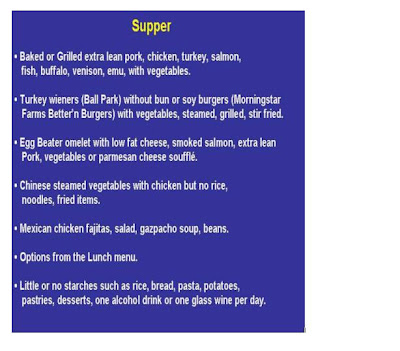
Now, I want to share to you some guides on how to have a nutritious food to prevent heart diseases or a guide even though you have heart problems. This one came from my wife and I requested her to share it with you. I hope this will help you in cholesterol and fat reduction. You must follow this simple guide for you to have a healthy living. Please take note that the following list is the recommended foods for our daily meals. Just follow the Food Pyramid: in which vegetables is the highest serving, and then fruits to fat--which is the lowest.
Have a healthy living to all of you!
PLEASE CLICK THE PICTURE TO ENLARGE!


Have a healthy living to all of you!
PLEASE CLICK THE PICTURE TO ENLARGE!


Subscribe to:
Posts (Atom)